/cdn.vox-cdn.com/uploads/chorus_asset/file/19295524/The_Outer_Worlds_art_cover.png) |
| https://cdn.vox-cdn.com/thumbor/QiNbi4kf54LOB5yjB5SVAEgVS54=/1400x1400/filters:format(png)/cdn.vox-cdn.com/uploads/chorus_asset/file/19295524/The_Outer_Worlds_art_cover.png |
I first took notice of The Outer Worlds when the first trailer was released last December. This new first-person sandbox RPG developed by Obsidian Entertainment piqued my interest with a trailer that looked energetic and fun in a way that Obsidian games had not yet been. My familiarity with Obsidian came from Fallout: New Vegas, and the infusion of frenetic tension with their proven aptitude for scope and storytelling looked promising.
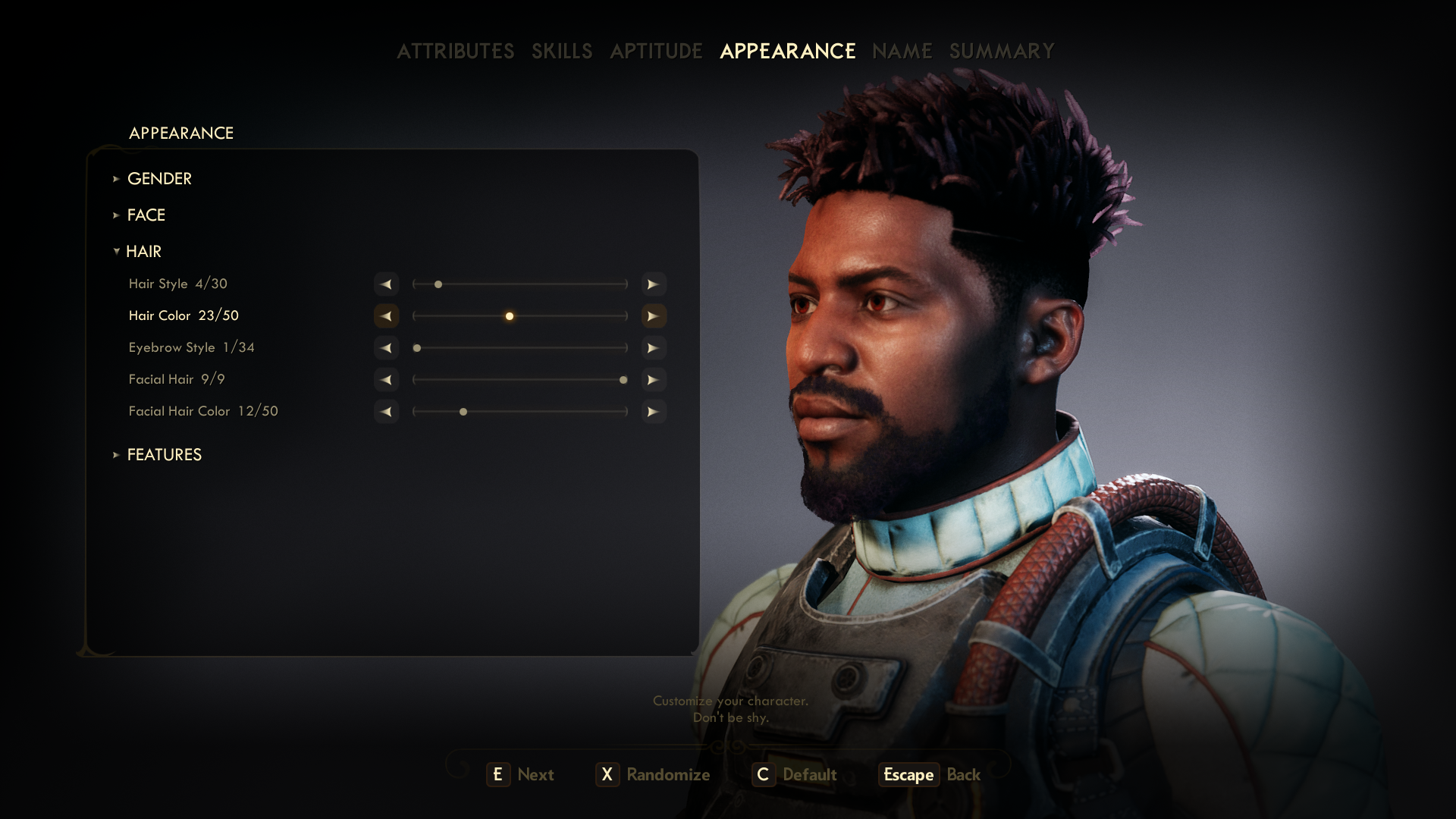
Fast forward to when the game released and I queued up a video to see what it was like. I was taken in first and foremost by the character creation mechanic, but soon after by the story and narrative structure that seemed familiar yet flavorful. It immediately felt like I knew the recipe so well that I was compelled to take my turn in the kitchen and I bought the game without much preamble.
Having now spent my time with the game, I've found that it is a mashup of successful elements from other games. In fact, as I broke the game down into bite-sized pieces, I've found allegories to help me describe each of them.
 |
| https://video-images.vice.com/_uncategorized/1571776929816-unknown-6.png |
Gameplay: While a class war rages on in Fallout 76 following the release of premium subscriptions, let's ignore that dumpster fire to talk about The Outer Worlds. Fallout is the dominant flavor in The Outer Worlds. The sequences of questing, combat, and looting are nearly identical to any Bethesda RPG. As a result, the game feels like the Fallout sequel that 76 wasn't. When many gamers look at The Outer Worlds, Fallout is what they see.
The comparison between Fallout and The Outer Worlds is easy: visually and narratively the games have some similarities, but in terms of gameplay The Outer Worlds follows Fallout step-for-step. Questing takes place in story hubs, typically settlements or groups of NPCs, and that is where the narrative is driven forward. Combat invites a variety of strategies and the game's "sandbox" style allows the player to choose how to engage enemies. Looting directly or indirectly improves the player's combat ability and draws the player out into the "sandbox" before looping them back through a story hub. This is the basic flow of any Bethesda RPG, and it's the same in The Outer Worlds except that where Bethesda RPGs provide huge and vibrant worlds to explore to the point that you can forget your quests altogether, Obsidian designed The Outer Worlds without that scope. Clear, direct paths dominate your map and moving away from them slows your progress with simple-minded enemies who offer little to no reward. As you clear these enemies for the hell of it, suddenly you find your game world feeling empty.
As a result, the player is disappointed to find themselves corralled and railroaded from point-to-point. The quest selection is too few and the story hubs feel like they have more closed doors than open ones. Ultimately, when the game is done you don't feel like you've had the Bethesda RPG experience--you feel like the game is far smaller than you had been led to believe. From high hopes at the beginning, The Outer Worlds disappoints as the story and narrative turn linear more in the style of Mass Effect. As you clear your quest log, you find that apart from a smattering of side quests offering pointless rewards, a quest for each companion, and the main story quest, there isn't really all that much to do. The Outer Worlds is less of a "sandbox" and more of a scavenger hunt--every location serves a purpose and, once that's done, you never need to go back.
To sum it up, The Outer Worlds starts by opening up and showing you such a wide array of possibilities for play style, for locations, for enemies, and so on that you get drawn in. Before long, however, you find that the game has run out of new things to show you. Your Assault Rifle gets replaced by an "Assault Rifle II", you don't get any new visuals or interactions. Not at all unlike the marketing strategies of corporations which the game satires, The Outer Worlds sells you on an incomplete experience ripe for monetization by DLC expansions in the future.
The comparison between Fallout and The Outer Worlds is easy: visually and narratively the games have some similarities, but in terms of gameplay The Outer Worlds follows Fallout step-for-step. Questing takes place in story hubs, typically settlements or groups of NPCs, and that is where the narrative is driven forward. Combat invites a variety of strategies and the game's "sandbox" style allows the player to choose how to engage enemies. Looting directly or indirectly improves the player's combat ability and draws the player out into the "sandbox" before looping them back through a story hub. This is the basic flow of any Bethesda RPG, and it's the same in The Outer Worlds except that where Bethesda RPGs provide huge and vibrant worlds to explore to the point that you can forget your quests altogether, Obsidian designed The Outer Worlds without that scope. Clear, direct paths dominate your map and moving away from them slows your progress with simple-minded enemies who offer little to no reward. As you clear these enemies for the hell of it, suddenly you find your game world feeling empty.
As a result, the player is disappointed to find themselves corralled and railroaded from point-to-point. The quest selection is too few and the story hubs feel like they have more closed doors than open ones. Ultimately, when the game is done you don't feel like you've had the Bethesda RPG experience--you feel like the game is far smaller than you had been led to believe. From high hopes at the beginning, The Outer Worlds disappoints as the story and narrative turn linear more in the style of Mass Effect. As you clear your quest log, you find that apart from a smattering of side quests offering pointless rewards, a quest for each companion, and the main story quest, there isn't really all that much to do. The Outer Worlds is less of a "sandbox" and more of a scavenger hunt--every location serves a purpose and, once that's done, you never need to go back.
To sum it up, The Outer Worlds starts by opening up and showing you such a wide array of possibilities for play style, for locations, for enemies, and so on that you get drawn in. Before long, however, you find that the game has run out of new things to show you. Your Assault Rifle gets replaced by an "Assault Rifle II", you don't get any new visuals or interactions. Not at all unlike the marketing strategies of corporations which the game satires, The Outer Worlds sells you on an incomplete experience ripe for monetization by DLC expansions in the future.
 |
| https://d1079ywfijtdjs.cloudfront.net/images/outerworlds/v2/video/poster/weapon-variants-1920.jpg |
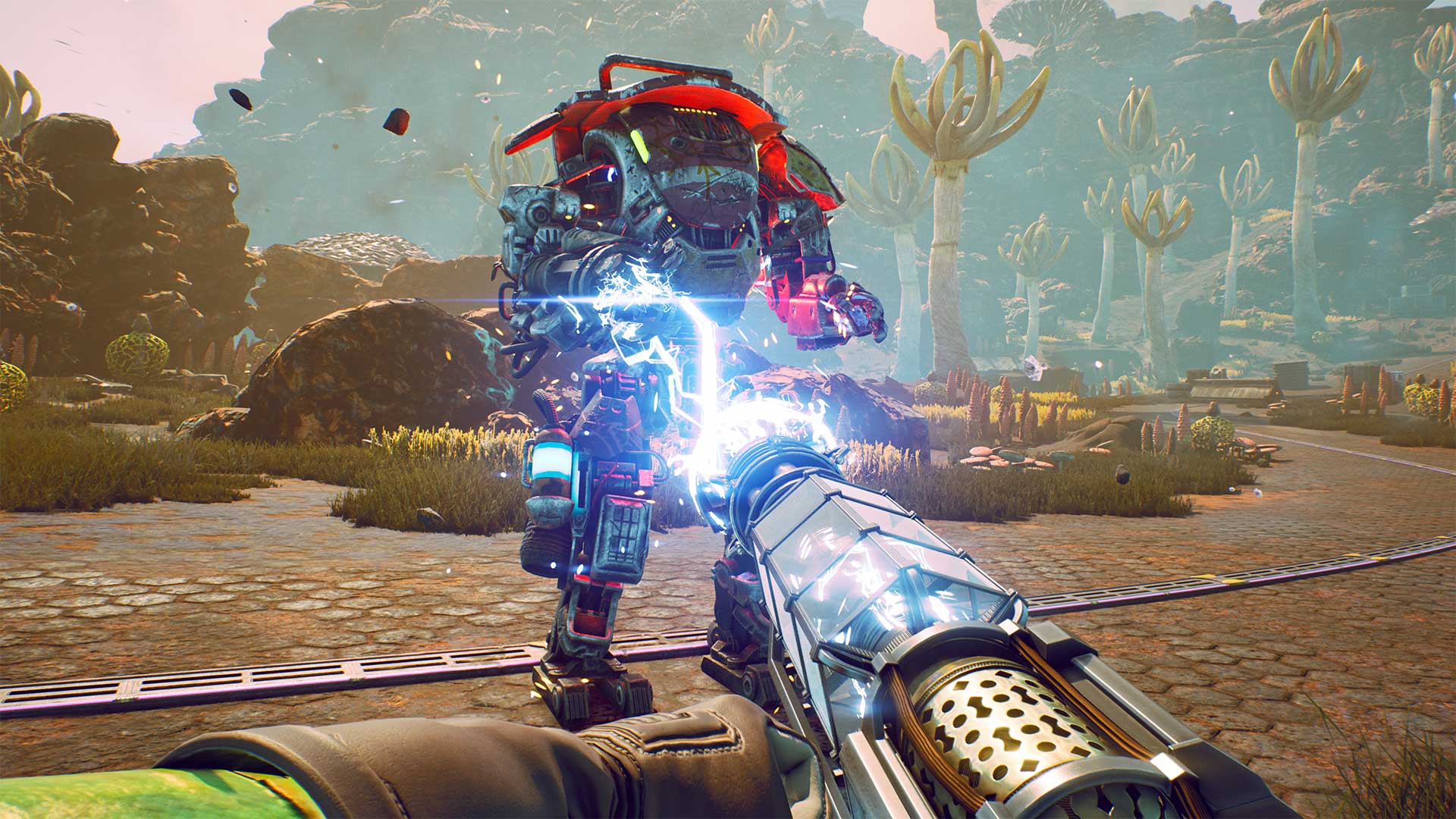
Visual Effects/Art Style: The visual elements of The Outer Worlds are stylized in a way that's reminiscent of Borderlands. There is further congruence in the role that corporations play in the game world. Lootable items are highlighted in a blue outline that leads the player to ignore other elements of the game world and makes it hard to perceive the details of the things you are looting. When you make a point of looking at the scenery, it seems like there was more attention to details than attention to the overall appearance. Individually, visual components are unique and interesting, but altogether they don't stand out from one another and they don't particularly feel like they fit into their settings. The environments feel like they were built-to-suit a linear and singular purpose leaving few paths for traversing and little reward for exploring. While the grass may look good to a pixel, it loses any appeal when it's the same textures over and over. The world doesn't feel lived-in, it feels manufactured and not in the satire-of-a-corporate-world kind of way. The artists did their job, sure, but the game ends up looking like it was built to a deadline and a budget.
Sound Effects/Music: I'm not sure if the soundtrack for The Outer Worlds was made before or after the rest of the game, but it doesn't connect to the experience. It offers a sense of wonder, space, and intrigue that the game itself utterly lacks. The soundtrack is good, but not fitting for this game. Can you imagine if the main menu theme was the introduction to an episode of Rick and Morty? Yeah, it's like that.
The voice acting is a bright spot that brings the various characters to life in a way the game does not. Milquetoast archetypes are livened by the acting and this makes for one of the best parts of the game. For the characters you spend time with, this feels right. For characters who only pop up a few times along the way, it's a bit jarring. On the one hand, you want to give time and attention to this part of the game and on the other hand you're hoping to find more narrative than most of these conversations ultimately offer you. This leaves you torn between slowing your progress and hunting for the experience you were promised. I'll spoil that search for you: take your time with the characters.
Story and Narrative: I've already mentioned the broad aspects of the story and narrative in the gameplay section, so I want to keep this short. The Outer Worlds lends itself to comparisons with Rick & Morty, Firefly, and Mass Effect. There's a crazy scientist on the run, a Robin Hood-esque captain trying to do a bit of good in a corporate galaxy, and a team of needy companions asking for someone to fix their dysfunctions. The story opens up after a few hours and the player is encouraged to find and complete quests at their own discretion, but this is only one layer deep. Completing quests means that the area they sent you to is now empty. The characters you helped lose interest in you, and as you complete hubs, you find that you have no reason to go back. The planets and towns aren't destinations and they aren't places you go to explore the game--and, for that matter, neither are the parts outside of the story hubs. The game is at its most memorable when it is also at its most linear. The "sandbox" in The Outer Worlds is the worst part of the experience and very likely one of the biggest reasons you would buy a Fallout-esque game by Obsidian Software. The linear sections seem to have been given more time and attention in development, but they don't last. It's like the game they wanted to make was too small, so they stuffed it with flavorless sandbox elements.
The Outer Worlds doesn't offer satisfaction like Skyrim does. Look at how a challenging quest made a moment for this Redditor:
Oh my god, I finally did it. After all this time. from r/skyrimThe Outer Worlds doesn't invite you to live in the world. When you go for a sandbox game, you want to act and think like you are really there like Fallout 4 did for this Redditor:
After spending countless hours perfecting a single settlement in FO4, I can't help but take offense when my settlers complain about "hard times" or how hungry they are. They live in a fucking resort compared to the rest of the Wasteland. from r/Fallout
 |
| https://media.comicbook.com/2019/02/the-outer-worlds-obsidian-microsoft-1160630-1280x0.jpeg |
Entertainment Value: With all of the remakes and remasters around today, The Outer Worlds doesn't suffer for being familiar. Mechanics and playstyles are easy to understand making the game easy to pick up and play. From the start, you'll feel like you're in control and although the game does expect you to figure out a lot of things by the time you gain your first level, you are helped by these things being similar to things other games you've played. This leaves The Outer Worlds difficult for new gamers and without a hook in the gameplay to keep old gamers.
The Outer Worlds starts well and finishes poor. Early on, the story and the world and the rapidly expanding options are enough to keep you excited to play. As the game wears on, the familiar and the repetitive aspects lose their luster. You are no longer finding new and interesting places to explore, you're just traversing as little as possible between fast travel points and skipping through dialog as you hunt for something to enjoy.
When I finished the game, I had no desire to keep playing. I wasn't interested in going back to try the other choices I could have made along the way. I felt like I had gotten the best experience the game had to offer for me. After a week of this, I did go back to try again to test those feelings. There is no new game plus, so from a new start I found myself rushing through the main story. I wasn't stopping to enjoy any part of the game. I now knew where to find everything, I knew that if there was a dialog option related to a skill I would choose it without reading, I knew that if I ran just far enough out of combat the whole area would reset sans whichever few enemies I had picked off the first time... In other words, I had solved the challenges. In a few minutes and on a higher difficulty, I had made more progress than I made in two hours on my first playthrough. The only thing to do was to rush along to major plot points, change the outcome, and then rush onto the next so that I could see two different sentences about my actions by the games' end.
In short, the game is entertaining once. You should wait to play this game. If they build the world up with DLC, that's a sign that you should wait longer. There is value in The Outer Worlds, there are brilliant moments and fun to be had, but it's nowhere close to worth it's price. Go play anything else and don't buy in until this game has more to offer.
Conclusion: The Outer Worlds feels familiar, but lacks it's own identity. The Outer Worlds fails to make a strong impression on the future of gaming, instead choosing to live in the past. There's nothing in the game that's on the cutting edge of game design or technology, and that makes it the sort of game you can put on your wishlist for awhile and wait for a deal. Don't hurry to play this game, find it in your own time or not at all--at this point it doesn't matter. If more is added to this game in the future, then it only moves itself closer to being worth your time rather than adding value to a complete product.
The Outer Worlds starts well and finishes poor. Early on, the story and the world and the rapidly expanding options are enough to keep you excited to play. As the game wears on, the familiar and the repetitive aspects lose their luster. You are no longer finding new and interesting places to explore, you're just traversing as little as possible between fast travel points and skipping through dialog as you hunt for something to enjoy.
When I finished the game, I had no desire to keep playing. I wasn't interested in going back to try the other choices I could have made along the way. I felt like I had gotten the best experience the game had to offer for me. After a week of this, I did go back to try again to test those feelings. There is no new game plus, so from a new start I found myself rushing through the main story. I wasn't stopping to enjoy any part of the game. I now knew where to find everything, I knew that if there was a dialog option related to a skill I would choose it without reading, I knew that if I ran just far enough out of combat the whole area would reset sans whichever few enemies I had picked off the first time... In other words, I had solved the challenges. In a few minutes and on a higher difficulty, I had made more progress than I made in two hours on my first playthrough. The only thing to do was to rush along to major plot points, change the outcome, and then rush onto the next so that I could see two different sentences about my actions by the games' end.
In short, the game is entertaining once. You should wait to play this game. If they build the world up with DLC, that's a sign that you should wait longer. There is value in The Outer Worlds, there are brilliant moments and fun to be had, but it's nowhere close to worth it's price. Go play anything else and don't buy in until this game has more to offer.
 |
| https://godhatesgeeks.com/wp-content/uploads/2019/06/maxresdefault-1.jpg |
Conclusion: The Outer Worlds feels familiar, but lacks it's own identity. The Outer Worlds fails to make a strong impression on the future of gaming, instead choosing to live in the past. There's nothing in the game that's on the cutting edge of game design or technology, and that makes it the sort of game you can put on your wishlist for awhile and wait for a deal. Don't hurry to play this game, find it in your own time or not at all--at this point it doesn't matter. If more is added to this game in the future, then it only moves itself closer to being worth your time rather than adding value to a complete product.